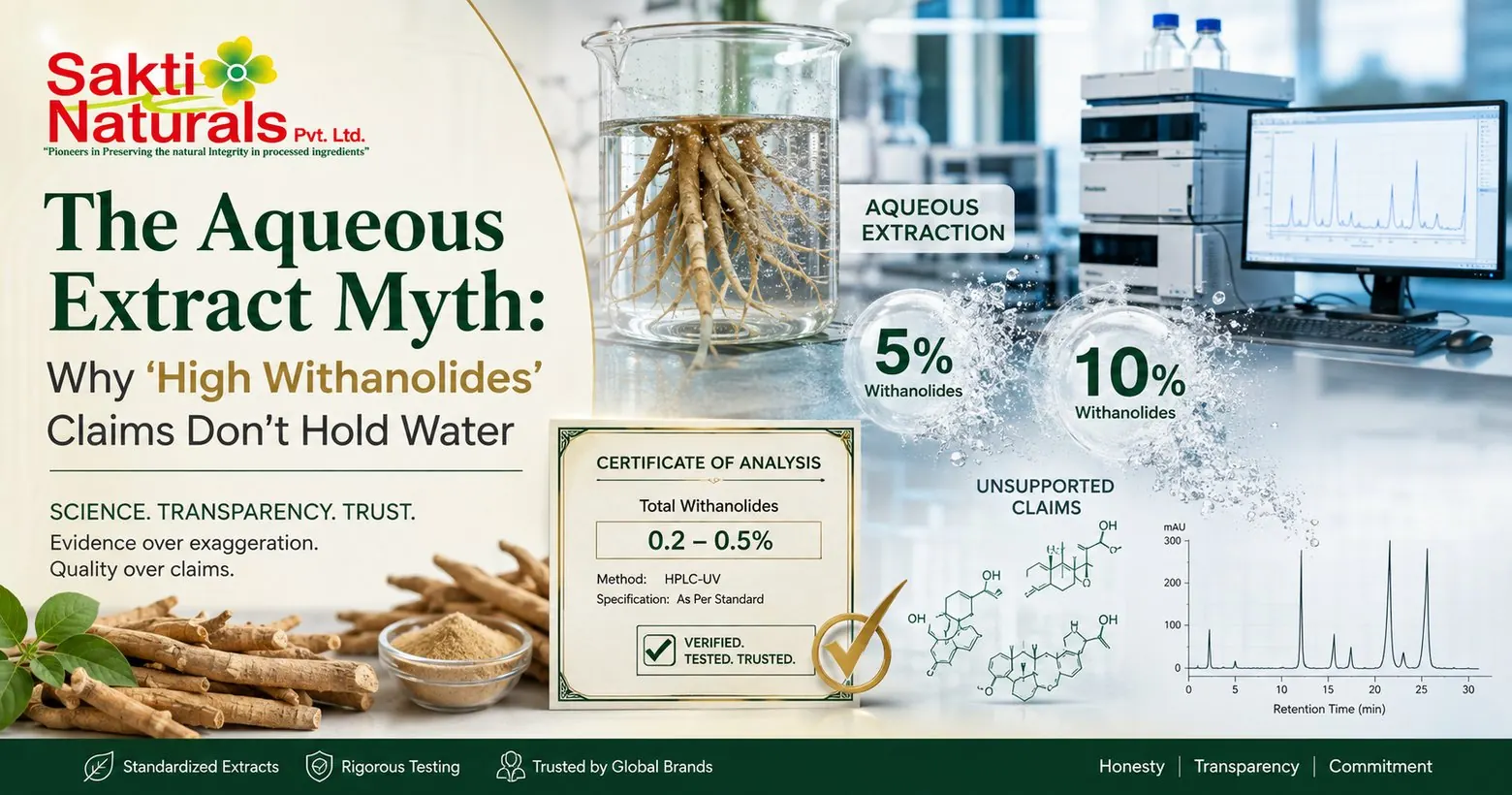
Pick up five different Ashwagandha aqueous extract quotations and you'll likely see five different withanolides percentages: 2.5%, 5%, sometimes even 10% total withanolides.
Here's the number that should stop you: the actual root, extracted in water, doesn't contain more than about 0.5% total withanolides on a weight-per-weight basis.
Not as a processing limitation. As a botanical one.
So where is the other 2%, 4.5% or 9.5% coming from?
The Number the Plant Can't Give You
Withanolides are steroidal lactones: potent, but present in the Withania somnifera root in genuinely small quantities to begin with. Water extraction, done properly, concentrates what's there. It doesn't manufacture more of it.
A claim of 5% or 10% total withanolides in an aqueous root extract isn't a processing achievement. It's a number that the raw material itself doesn't support, which means the gap has to be coming from somewhere else:
- A different plant part with an unrelated withanolides profile
- A calculation against the wrong reference standard
- A blend with solvent-concentrated fractions
- An assay method that isn't measuring what the label claims
None of that shows up as a red flag on a spec sheet. It shows up as a number that looks better than the last quote.
This Isn't the First Time We've Made This Argument
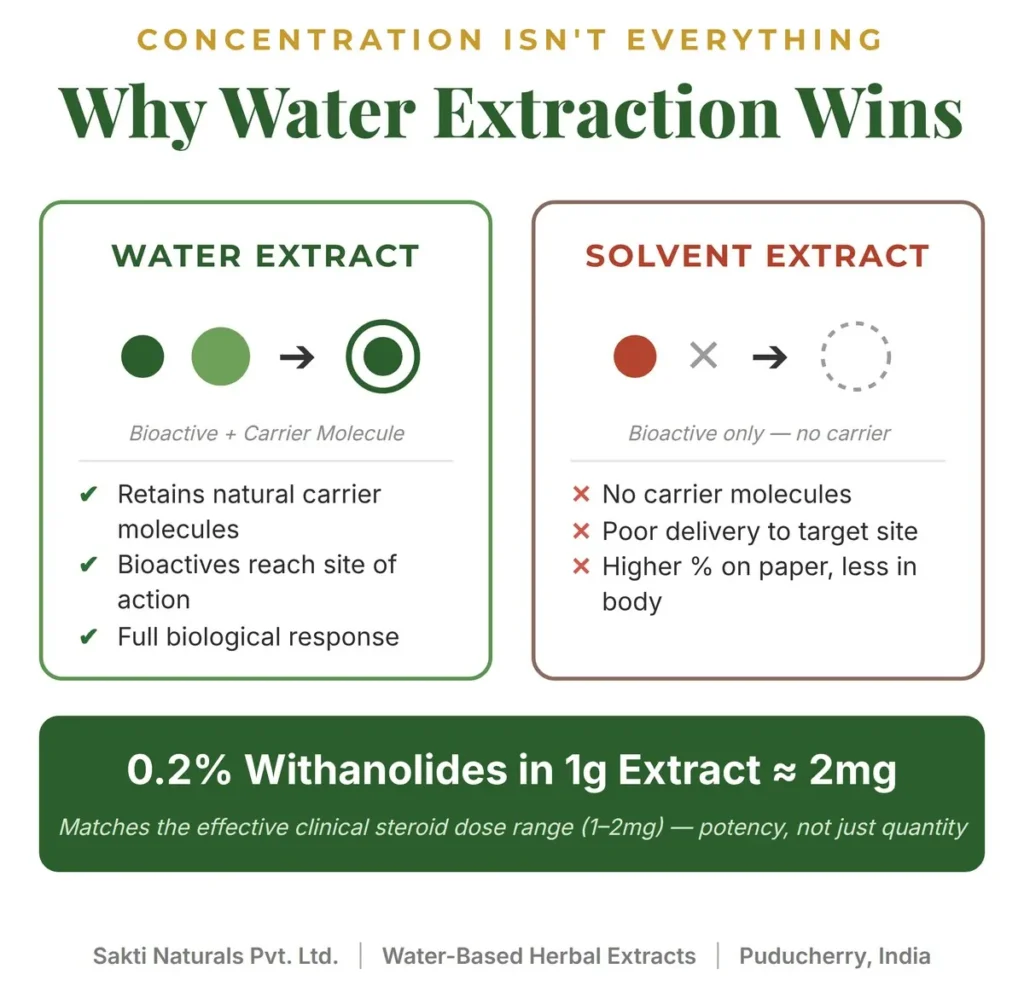
We wrote a few weeks ago about why concentration isn't everything in herbal extraction: a solvent extract can show a higher bioactive percentage on a Certificate of Analysis while delivering less actual biological effect, because the carrier molecules that transport withanolides to their site of action get stripped away in the process.
The withanolides inflation problem is the same failure of logic, wearing a different mask. Both start from the same false premise: that a bigger number on a COA automatically means a better ingredient. It doesn't. It usually means a more aggressive process, a more convenient reference standard, or a less honest label.
Why 0.25% Was Already Enough
Withanolides behave like other steroidal compounds: active in small doses. We made this point using prednisolone as a reference, which is clinically effective at just 1 to 2mg. A 1g dose of extract at 0.2% withanolides delivers ~2mg, comfortably inside the range needed for a biological response.
Which means a real, honestly standardized extract at 0.25% total withanolides isn't underpowered. It's already doing the job the plant is capable of doing. A supplier claiming 10x that concentration from the same raw material isn't offering you a stronger product. They're offering you a number that the chemistry of the root can't actually justify.
The Questions Worth Asking Before You Believe the Percentage
- What method was used to quantify total withanolides, and against which reference standard?
- Is this the aqueous extract of the root alone, or a blend involving other plant parts or solvent-concentrated fractions?
- Can you show me the raw material's baseline withanolides content before extraction?
- If I sent this COA to an independent lab, would the number hold?
A supplier standing behind a modest, honest 0.2 to 0.5% will answer all four without hesitation. A supplier standing behind 5% or 10% usually can't, because the answer isn't a processing secret. It's an admission that the number doesn't come from where the label says it does.
The Real Standard
We're not chasing the highest withanolides percentage we can put on a spec sheet. We're standardizing to what the root actually contains, because a number the plant can't back up isn't potency. It's marketing dressed up as chemistry.
If you're sourcing Ashwagandha extract on withanolides percentage alone, write to us at exports@saktinaturals.com. We'll show you what an honest, verifiable COA looks like next to the one you have now.