Walk into any pharmacy and pick up a paracetamol tablet for a headache or fever. Roughly 99.5% of what's in that tablet is known, quantified and measured. The manufacturer can tell you exactly what's in it, down to the last excipient.
Now pick up an Ashwagandha capsule off a nutraceutical shelf. How much of that product is actually quantified?
In most cases, it's 2 to 10%.

The Industry's Blind Spot
Herbal extract manufacturers routinely standardize their products against a single marker or up to 5 marker compounds (withanolides in Ashwagandha, for instance) and call it done. The remaining 90%+ of the material goes unmeasured, unquantified and largely ignored.
Why? Because the industry has convinced itself that only the "active" matters. Everything else is treated as inert filler, not worth the analytical effort.
But that assumption is where the myth lives.
What's Actually in That Missing 90%?
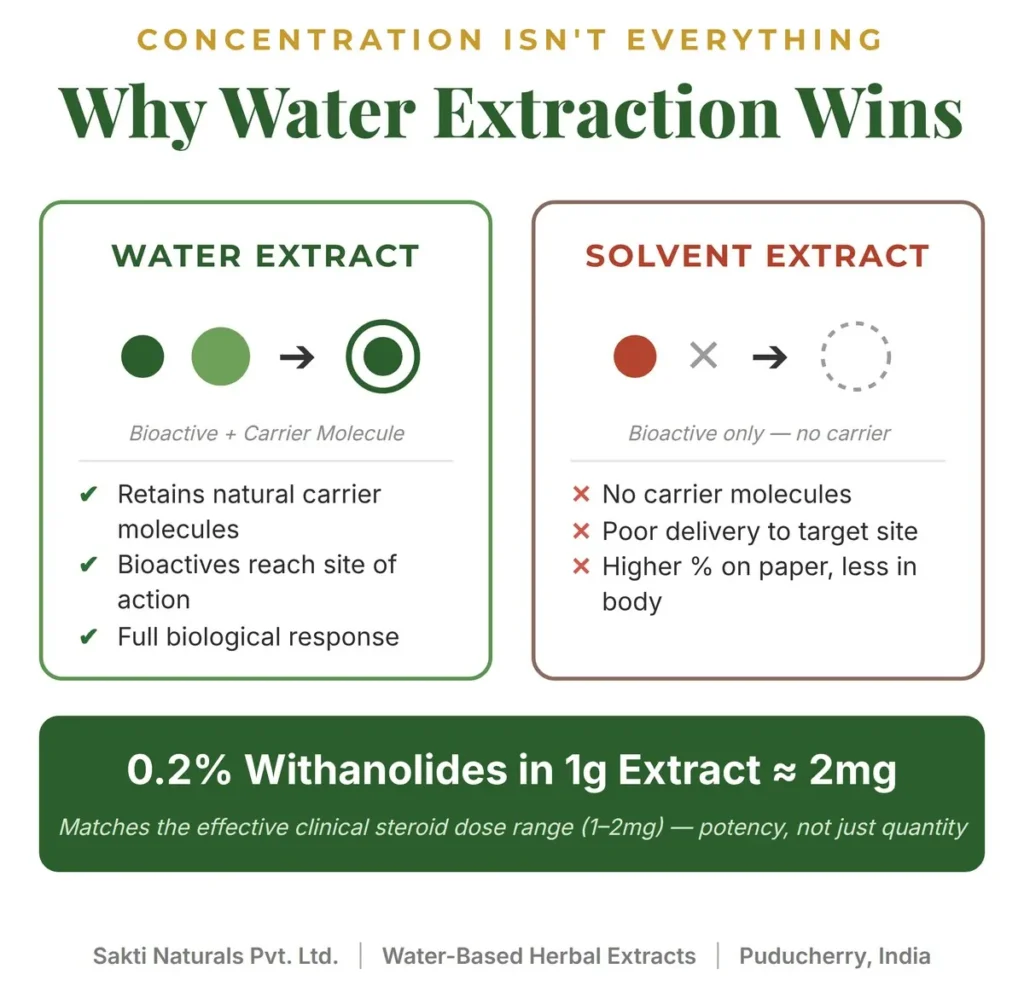
The unquantified portion isn't just noise. It includes carrier molecules that play a critical role in how the active compound is absorbed, transported and delivered to its site of action in the body.
Skip the carrier molecules, and even a perfectly quantified active may never reach where it needs to go. Standardizing 5% of a product while ignoring the delivery system behind it isn't standardization. It's a partial picture presented as a complete one.
Where the Bar Should Be
A product defined at 2 to 10% of its total content, with 90%+ left unknown, cannot honestly be called "fully standardized." Real standardization means quantifying and consistently delivering a meaningful majority of the material: at minimum, 50% of the content should be analyzed, quantified and standardized, batch after batch.
Anything less is a marketing claim dressed up as a scientific one.
Why This Matters for You
If you're a nutraceutical formulator, brand owner or sourcing manager, the extracts you build your product on are only as reliable as the standardization behind them. A marker-compound-only approach might satisfy a label claim, but it won't protect you from batch-to-batch inconsistency, unpredictable efficacy, or the reformulations and delayed approvals that come with it.
The question worth asking your supplier isn't "Is it standardized?" It's "How much of it is actually standardized, and consistently so?"
A Better Standard, Practically Applied
At Sakti Naturals, we standardize our extracts well beyond a single marker compound, because a formulation is only as consistent as the ingredient behind it.
If you're evaluating your current supplier's standardization claims, write to us at exports@saktinaturals.com. We'll show you what a side-by-side specification and COA review looks like on your own formulation.
Let's move the industry past the myth, one batch at a time.